The Plaier Movement: Reimagining Work in the AI Era
Discover the movement reshaping how teams work with AI—with clarity, momentum, and purpose.

Leandro & Daniel
The Plaier Movement: Reimagining Work in the AI Era
There’s a shift happening in how the best organizations approach AI.
They’re not asking, “What’s the latest AI trend?” They’re asking, “How do we build a culture where people can move faster and smarter with AI?”
They’re not hiring for “AI expertise.” They’re building teams of Plaiers — people who can navigate ambiguity, activate AI, and drive outcomes.
This is the Plaier Movement.
What’s the Plaier Movement?
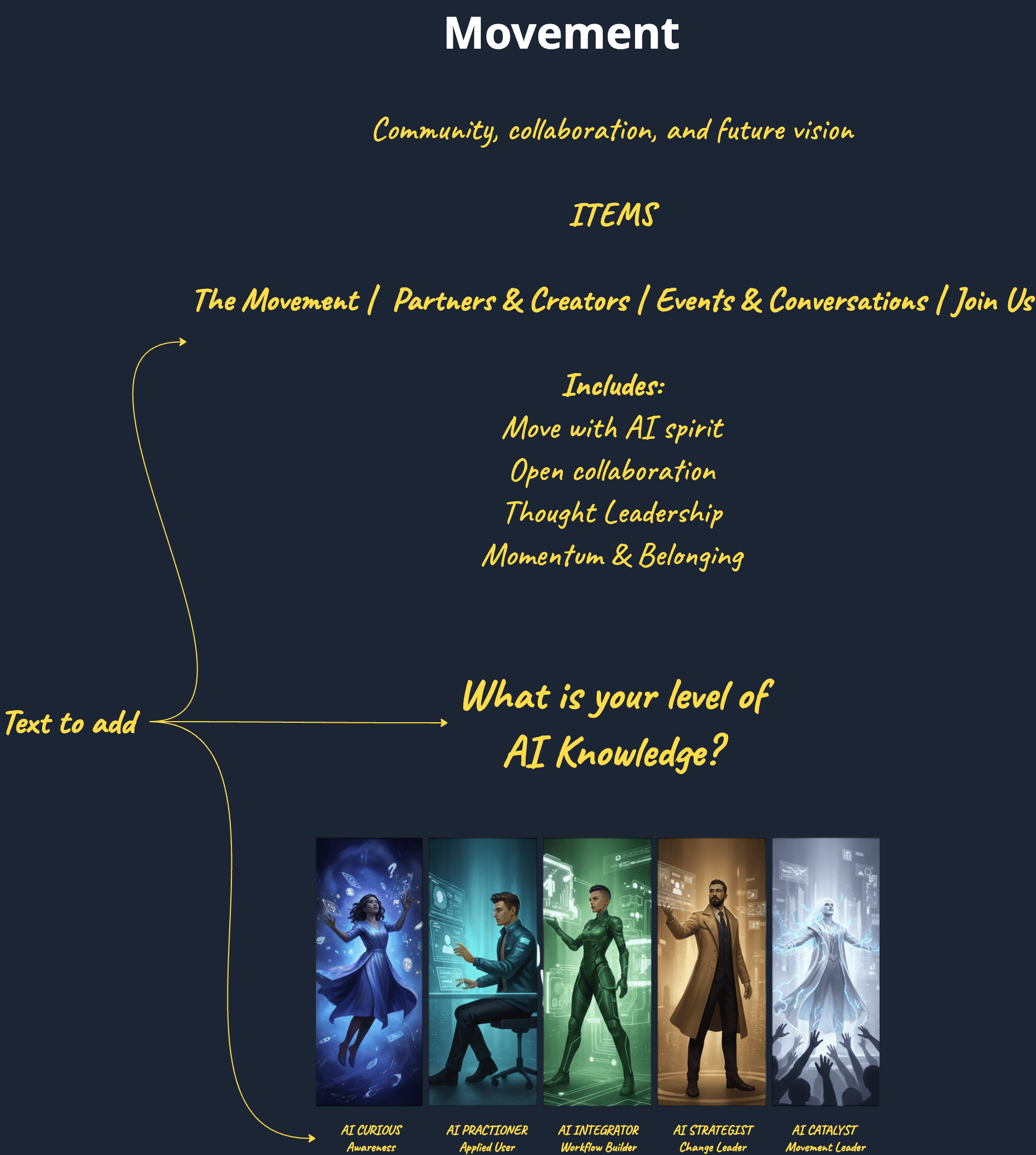
The Plaier Movement is a shift in how organizations think about AI and people:
Old thinking: AI is a tool. We need AI experts. We buy AI solutions.
Plaier thinking: AI is a capability. We need people who can think and play with AI. We build AI into how we work.
This distinction matters enormously.
The Problems with AI Expertise
Organizations have been trying to solve AI adoption the wrong way:
Problem 1: Waiting for Experts
Most organizations say, “We need AI experts. Let’s hire them. They’ll show us how to use AI.”
But good AI experts are rare and expensive. And by the time you hire them, the landscape has shifted.
More importantly, AI expertise isn’t what you need. You need people who can work with AI, think about AI, experiment with AI. That’s different.
Problem 2: Siloing AI
Organizations create “AI teams.” These teams are supposed to be innovation engines. But they often become silos:
- AI team builds cool models
- Rest of organization doesn’t understand them
- Models don’t get embedded into real work
- Everyone keeps working the old way
- AI team is frustrated that nobody gets it
Problem 3: Tool Obsession
Organizations buy AI tools hoping that owning the tool solves the problem.
But the tool doesn’t matter without the right people. You can have the best LLM access in the world, but if your team doesn’t know how to think about using it, nothing changes.
What Plaiers Actually Do
Plaiers are different from “AI experts.”
Plaiers don’t necessarily have PhDs in machine learning. They don’t write algorithms. They might not be technical at all.
Instead, Plaiers:
Think in terms of capabilities, not tools. They ask: “What are we trying to achieve? What would change if we could process data 100x faster? What would we do if we had real-time insights?”
Experiment fearlessly. They try things. Some work. Some don’t. But they move. They learn by doing, not by theorizing.
See the boundaries between domains. They’re not siloed in one function. They understand Sales AND CS AND Operations AND Products. So they can see where AI creates leverage across the organization.
Activate others. They don’t hoard expertise. They help others learn. They show what’s possible.
Measure outcomes, not activity. They don’t celebrate that they “used AI.” They celebrate that something measurable changed for the customer or the business.
Why Plaiers Matter
The organizations winning with AI have one thing in common: They have Plaiers.
Not just in the AI team. But distributed across the organization.
Example: Sales Organization
Traditional: “We have an AI tool that predicts which customers are at risk.”
- AI team built the model
- Sales team doesn’t fully understand it
- Adoption is slow
- Results are mediocre
With Plaiers: “We have sales people who think about how AI could help them close faster.”
- A sales Plaier asks: “How could we use data to know which customers are ready to expand?”
- She experiments with AI tools that surface expansion signals
- She shows teammates what she’s doing
- Expansion revenue increases 30%
- Other reps want to learn
Example: Customer Success
Traditional: “We have a health score that predicts churn.”
- CS platform gives everyone the same metric
- CS reps follow the system
- Some customers churn anyway
- Nobody understands why the metric missed them
With Plaiers: “We have CS leaders who think about what would make us better at retention.”
- A CS Plaier asks: “What if we could predict churn from actual behavior, not lagging indicators?”
- She works with data team to create early indicators
- She tests proactive interventions
- Churn decreases 25%
- The insight gets embedded into the process for everyone
How Organizations Build a Plaier Movement
You don’t hire Plaiers. You grow them. Here’s how:
1. Reframe the Narrative
Stop saying: “We need AI experts” Start saying: “We need people who can think about how AI changes our work”
This opens the door to people who might not have “AI” on their resume, but have curiosity, adaptability, and problem-solving skills.
2. Give Permission to Experiment
Plaiers need space to try things that might not work.
Create a small budget for experimentation. Give people 10% of their time to explore. Celebrate learning from failures.
3. Distribute AI Literacy
Don’t keep AI knowledge in one team. Spread it.
- Monthly lunch-and-learns where Plaiers share what they learned
- Workshops on how to think about AI problems
- Access to AI tools for people across the organization
- A Slack channel where people ask questions and learn together
4. Connect Plaiers Across Functions
Plaiers are most powerful when they’re not siloed.
- A sales Plaier connects with a product Plaier
- They collaborate on ways AI could improve customer outcomes
- Insights flow both directions
- The whole organization moves faster
5. Celebrate Plaier Stories
Share what worked. Tell the stories of people who moved fast, learned something, and created value.
Don’t wait for the perfect case study. Share the experiments. Share the wins and the failures.
The Culture of the Plaier Movement
Organizations with strong Plaier movements have a specific culture:
Curiosity over certainty. People ask questions. They’re comfortable not knowing. They explore.
Movement over perfection. People ship, then refine. They don’t wait for the perfect solution.
Experimentation over planning. People learn by doing. They test assumptions with small experiments, not big plans.
Connection over isolation. People share what they’re learning. Insights flow between teams.
Outcomes over activity. People are measured on what changed, not what they tried.
What Gets Better
Organizations with strong Plaier movements see:
✅ Faster AI adoption — it’s not a separate initiative, it’s embedded in how we work ✅ Better ideas — insights come from people closest to the work, not just the AI team ✅ More engaged employees — people feel like they’re learning and building something ✅ Measurable business impact — experiments are designed to move the needle ✅ Retention of top talent — the best people want to work in a culture of learning and movement
Getting Started
If you want to start a Plaier Movement in your organization:
-
Find one person who’s naturally curious about AI. This is your first Plaier.
-
Give them a problem. Not “explore AI.” But “We’re struggling with X. How could AI help?”
-
Support their experiment. Give them tools, time, and access to data. Let them play.
-
Share what they learn. Tell the story of their experiment to the organization.
-
Find the next Plaier. As people see what’s possible, others will want to learn and play.
Repeat. The movement grows.
The Bigger Vision
The Plaier Movement isn’t about AI. It’s about building organizations where:
- People are empowered to think and act
- Experimentation is encouraged
- Learning is continuous
- Outcomes matter more than perfection
- Movement matters more than theory
This is what organizations need in the AI era. Not AI experts. But a culture of Plaiers.
Who are the natural experimenters and curious thinkers in your organization? Start with them. Give them permission to play. The movement begins.
Tagged with: